
OMS vs EMS: Which System Does Your Trading Desk Really Need?
Today’s digitally-driven financial markets have become faster than ever. Efficiency, precision, and automation have become elements critical to market success.
Now, if you are a market player who operates a trading desk, you too would be relying on advanced software systems to manage orders, execute trades, and ensure compliance.
Amongst the various tools trading desks use, two choices that stand out include Order Management System (OMS) and Execution Management System (EMS).
Both serve distinct purposes and have a unique significance in the modern financial market ecosystem. Therefore, usually, as many trading desks do, if you also feel confused between choosing OMS and EMS, this blog will help you. While comparing OMS vs EMS, it highlights the differences between both, pros and cons, and explains when to choose what.
What is an OMS Order Management System?
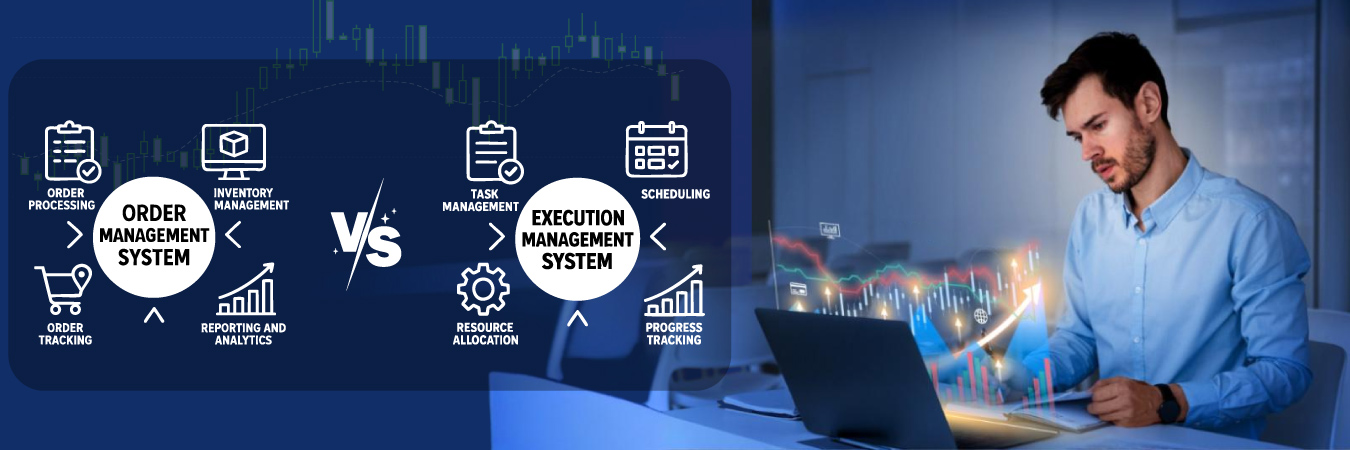
An OMS is a platform that manages the entire order lifecycle. Therefore, from creating orders and routing to allocation and post-trade processing, an OMS platform does it all.
Primarily, buyer-side firms such as mutual funds and asset managers use an OMS. The system enables them to handle large trade volumes across different portfolios and asset classes.
Accordingly, the system helps them ensure compliance and make efficient settlements.
Some key functions an OMS performs include;
- Order creation, validation, and routing
- Order aggregation and allocation
- Portfolio and risk management
- Pre-trade compliance checks
- Post-trade reporting and reconciliation
What is an EMS Execution Management System?
Now, let’s see what an EMS is. As the name suggests, an EMS helps execute trades quickly and efficiently across different venues. Firms like sell-side traders, high-frequency trading desks, and hedge funds that prioritize speed, market connectivity, and execution quality use EMS platforms. Some key functions of an EMS platform include;
- Direct market access (DMA)
- Real-time market data and analytics
- Smart order routing
- Algorithmic and high-frequency trading support
- Execution performance analysis
Essentially, an EMS platform focuses on executing trades and optimizing them. Hence, traders who need agility while operating in the dynamic market ecosystem choose EMS.
OMS vs EMS – Key Differences Between Both
Since OMS and EMS serve distinct purposes, they are different in various aspects and across numerous parameters. Here’s a comprehensive view to help you get a better idea of the key differences between these platforms.
| Feature | Order Management System (OMS) | Execution Management System (EMS) |
| Basic Goal | Ensuring workflow, compliance, efficient record keeping | Focuses on best execution, and liquidity aggregation |
| Core Function | Creating, tracking, and allocating orders efficiently | Effective routing, optimal execution and monitoring fills |
| User Base | Portfolio managers, compliance, middle/back Office | Traders, and execution specialists |
| Trading Stage | Pre-trade (compliance, order generation) and post-trade (allocation) | Trade (execution, real-time market access) |
| Focus | OMS focuses on maintaining order integrity and supporting the entire order lifecycle | EMS focuses purely on the order’s speed and quality |
| Market Data | The system is usually less granular, focused on security master data and static pricing | Real-time, low-latency market depth |
| Pre-Trade Check | Hard checks (e.g., compliance, cash availability, position limits) | Soft checks (e.g., market impact, venue choice) |
| Order Routing | Directs the order to the EMS or broker for execution | Routes the order to the market/venue |
| Algo Trading | Usually, initiates the large block order that will use an algo | Consists of the native suite of execution algorithms and SOR logic |
| Compliance Scope | Wide-ranging, covering regulatory, internal, and portfolio mandates | Narrower, focused on trade-related rules |
| Speed Requirement | Stability and reliability are critical and of utmost importance. Besides, speed is crucial but not ultra-low-latency. | Ultra-low-latency for market access is often a critical requirement |
| Post-Trade | Handles trade allocations, settlements, and reporting effectively | Provides data for Transaction Cost Analysis (TCA) and audit trail |
OMS vs EMS – Pros and Cons
Whether OMS or EMS, both have their pros and cons of which trading desks must be aware to make an informed choice. Let’s look at some of them.
Pros and Cons of OMS
Pros
- Manages orders and portfolios centrally
- Provides multi-asset support and seamless integration with back-office systems
- Offers solid compliance and audit capabilities
- Efficient trade allocation and reporting
Cons
- Has limited real-time execution tools
- May lack deep market connectivity
- Works slower in high-frequency environments
Pros and Cons of EMS
Pros
- Provides real-time market data and analytics
- Offers direct market access for quick execution
- Ensures support for algorithmic and high-frequency trading
- Enables smart order routing to ensure best execution
Cons
- Offers limited portfolio management capabilities
- Doesn’t have a strong compliance and post-trade functionality
- Can involve substantial implementation costs and complexities
OMS vs EMS – When to Choose What?
Choosing between the both requires carefully considering factors like the trading desk’s structure, objectives and scale. Accordingly, here’s when to choose what.
| Situation | Choice |
| Your priority is speed, execution quality and real-time market access | EMS |
| You are an asset manager who manages numerous portfolios and focus on compliance and post-trade workflows | OMS |
| You operate hybrid trading desk, which does institutional and active trading | Integrated OMS-EMS |
| You depend significantly on algorithmic trading or high-frequency strategies | EMS |
| You require comprehensive audit trails and regulatory control | OMS |
| You want to conduct front and back-office operations seamlessly | Integrated OMS-EMS |
| You manage multiple client accounts and require auto- and compliant execution allocation to specific portfolios | OMS |
| Your trading is low-frequency or long-term | OMS |
| You want best execution to be your differentiator in the market | EMS |
| Your orders come from simple, quick source | EMS |
| You are involved trading complex strategies | EMS |
Connect with FIXSOL for OMS / EMS Services
Practically, there’s no podium winner between OMS and EMS. Making the right choice is about aligning technology with trading strategy and operational requirements.
For example, OMS forms the backbone of trading operations for buy-side firms. On the other hand, an EMS provides speed and precision for sell-side desks and hedge funds. However, for even more complex, modern trading environments, a blend of both helps trading desks achieve and optimize each benefit.
Now, while choosing the right platform between an OMS, EMS or integrated solutions matter, the OMS EMS vendors you select also plays a crucial role. They help you navigate the complexities of both, enabling you to make the most from each based on your needs.
This is where FIXSOL comes into play. We develop both, based on a trading desk’s technical, operational and strategic requirements. Our experts understand and analyze your needs to design an OMS or EMS platform that aligns with your objectives and vision. Therefore, while providing an operational edge, our platforms with various features, build a strategic advantage as well. Some key features include;
- Direct Exchange Connectivity
- Real-Time Market Feed
- Integrated Risk Management and Compliance
- Order and Trade Flow Management
- APIs for Back-Office and Database Integration
- Quick and Clear Reporting Tools, etc.,
Would you like to know more about our OMS and EMS platforms? Then, click to explore and email us at sales@fixsol.com to discuss your requirement in detail.